How to analyse an inbound link profile: the method, not the score
A total of inbound links decides nothing. The five questions to ask a profile, how to count referring domains without counting them twice, what a purchased risk score is actually worth, and the one competitive comparison that produces a finding.
The NessFlow team (Product engineering, NessFlow) · · 5 min read
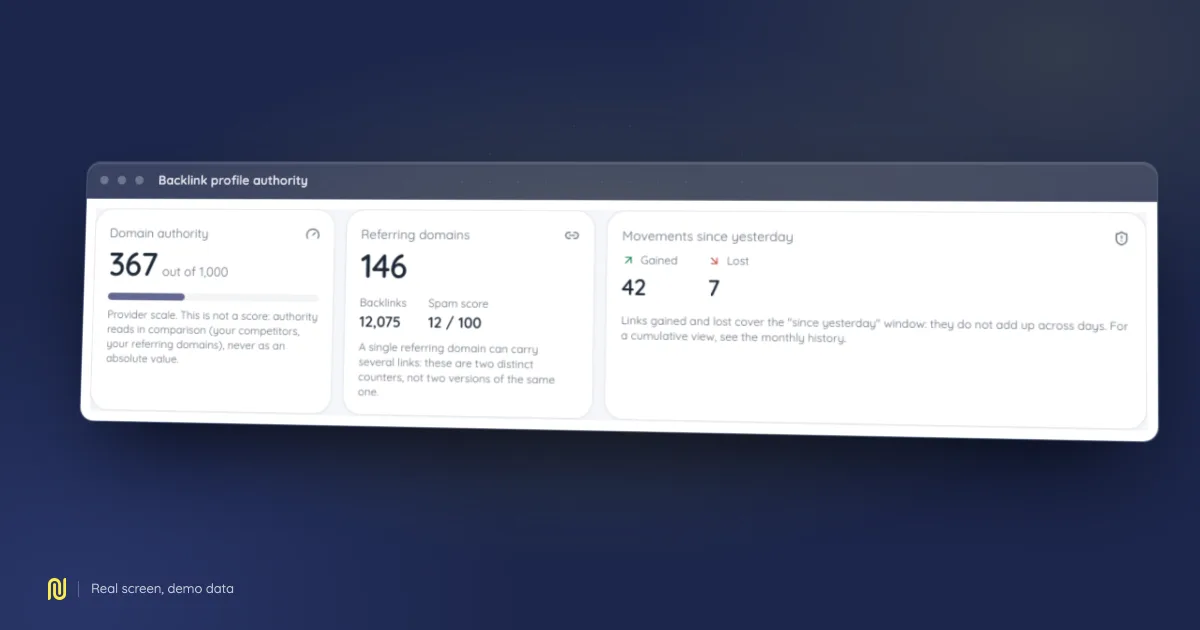
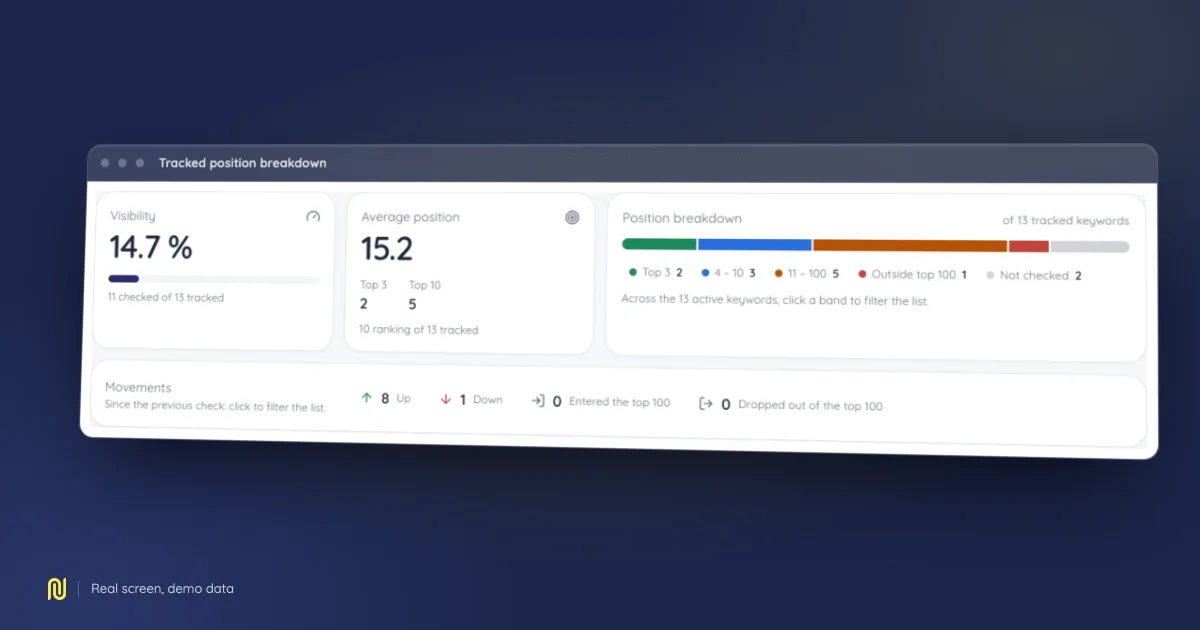
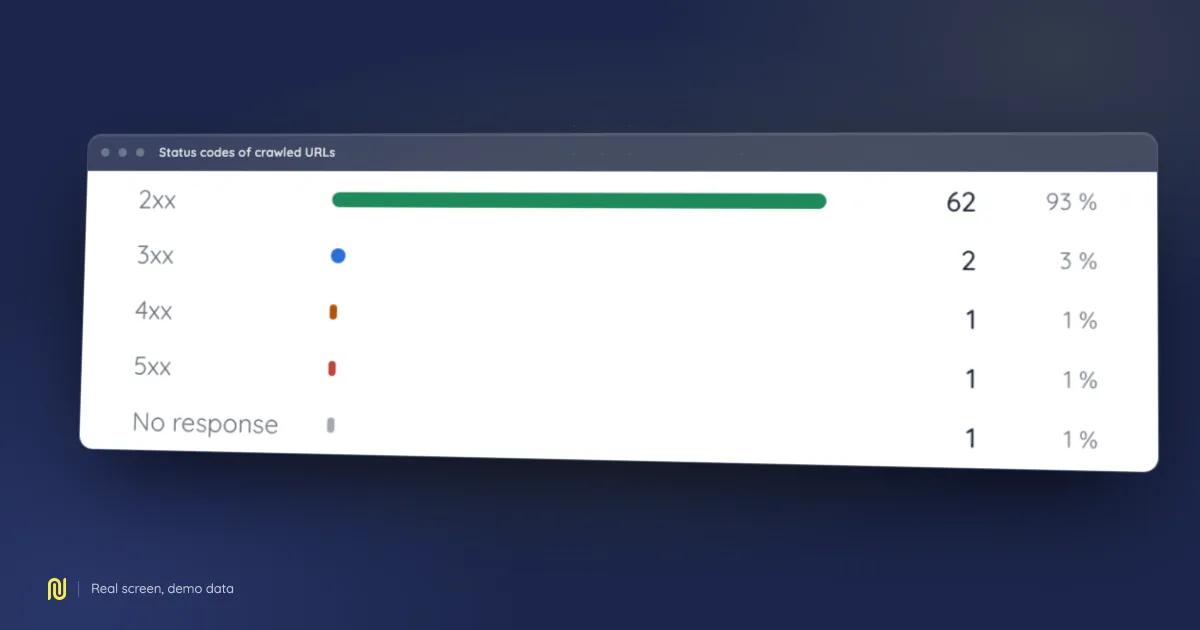
A real product screen, rendered on a fictional demo dataset: the figures shown belong to no client.
Every link tool opens with a large number, then an authority score. Both read in one second and settle nothing: the number aggregates links that have no common measure, and the score is a proprietary model you can neither reproduce nor contest.
This guide proposes the opposite: the questions to ask a profile, in the order they pay off.
The five questions, in this order
- How many DOMAINS, rather than how many links? A thousand links from forty sites describe a profile of forty sources. The referring domain count is the useful quantity; the link count mostly reveals which page templates cite you in a footer.
- What is moving? Movement tells you more than state. A profile gaining ten domains and losing twelve every month is flat in total and quietly deteriorating.
- Where do the gains come from? A directory, a press release copied across thirty sites and a substantial article carry different weight, and a rising total can describe an accumulation of worthless sources.
- Which anchor texts? The distribution of anchor texts says what your sources believe you do. One anchor dominating the whole profile is the signature of a campaign, and it is visible from the outside.
- Which pages receive? A profile concentrated on the homepage supports no content page. This is the finding that triggers the most concrete action, and almost nobody looks at it.
None of the five needs a score. They need counters, a date, and the ability to compare two readings.
Counting domains without counting them twice
A link index thinks in HOSTS, not sites. example.com and www.example.com are two entries there, sometimes three with a blog subdomain. A table that adds them up overstates your number of sources; a table that arbitrarily keeps the first entry understates your links.
The rule that works: reduce hosts to the domain, then aggregate instead of choosing.
- link counters add up;
- rank, or any authority measure, keeps the best of the hosts: authority does not add up;
- a risk score keeps the worst of the two, because understating a risk amounts to hiding it;
- the first appearance keeps its earliest date.
That last line is what makes link age usable. Without it, a simple host change at your source would make a three-year-old link look brand new.
Three states, never two
This is the distinction most dashboards lose, and it costs as much here as anywhere else.
- Measured: the reading happened, the value is what it is.
- Measured at zero: the index answered, and it found no link gained over the period. That is a dated fact.
- Not measured: the reading did not happen. Quota, outage, rejected request, collection still running. That is nothing.
One mechanical detail makes the distinction unavoidable: a profile's totals and its gained-or-lost counters come from separate calls. The first can succeed while the second fails. A table writing zero into the missing counters would draw a month with no gains at all, on a collection that simply never completed.
What a risk score is worth
Every link index publishes a risk rating under some name. Three things to know before showing one to anyone.
It is proprietary. No published method, no reproducibility. Two providers give two different ratings for the same domain, and neither will say why.
It says nothing about a penalty. A high score flags a questionable neighbourhood; it proves no sanction, and no engine will ever confirm the opposite either.
It is useful for sorting, not for verdicts. Sorting a thousand-domain profile by descending risk surfaces the twenty worth looking at in seconds. That is precisely what a human has no time to do by hand, and that is where the number's value stops.
Our position on this kind of value is the same as for any purchased measurement: it is shown with its origin, and it never becomes an in-house rating that could no longer be challenged.
The competitive comparison, properly framed
This is the one use of a link index that produces a finding you could not obtain otherwise: which sites cite your competitors without citing you.
Two precautions decide whether the result is usable.
The intersection must be PARTIAL. Asking for domains that cite all your competitors empties the list by the third declared competitor: very few exist. Asking for those citing at least one produces a workable list, provided you show how many competitors each source covers. A domain citing all three is a strong signal; a domain citing only one may be a commercial partnership.
The choice of competitors decides everything else. Three badly chosen competitors produce an off-topic list, and nothing in the result will say so. The soundest anchor is empirical: the domains that actually surface on your queries, recorded by your rank tracking, rather than a list drawn up in a meeting.
One last piece of honesty, the one tools keep quiet: a list of sources citing a competitor and not you is not a list of links to obtain. It is a list of sites to examine. Filtering, editorial judgement and outreach stay human work, and no tool shortens that part.
What a link profile will never tell you
- The weight of a link in the ranking. No engine publishes it. Any displayed weighting is a model.
- Causality. A link earned in the same month as a ranking gain does not explain the gain.
- What a source is worth to YOUR market. A specialist publication with modest measured authority can be worth ten general directories.
Those three unknowns are why we put no score out of a hundred on a link profile. A composite rating built from quantities of different natures reads like a measurement and argues like an opinion.
Where to start
- Count your referring domains, not your links, and track that count over time.
- Look at losses before gains: a lost source was already earned.
- Sort by risk once, to see what your profile is made of.
- Look at the distribution of receiving pages. It is the question that produces the most action.
- Frame the competitive comparison on measured competitors, and read it as a list to examine.
None of this needs an acquisition budget. All five steps run on an existing profile, and they almost always say something the large number at the top of the screen was hiding.