Our beta is invite-only, and we are recruiting difficult sites
An audit tool grows up on the sites its authors picked, which makes them the easiest sites in the world. We are opening an invite-only phase to put ours in front of sites nobody here chose, and here are the seven traits that put an audit tool in the wrong.
The NessFlow team (Product engineering, NessFlow) · · 5 min read
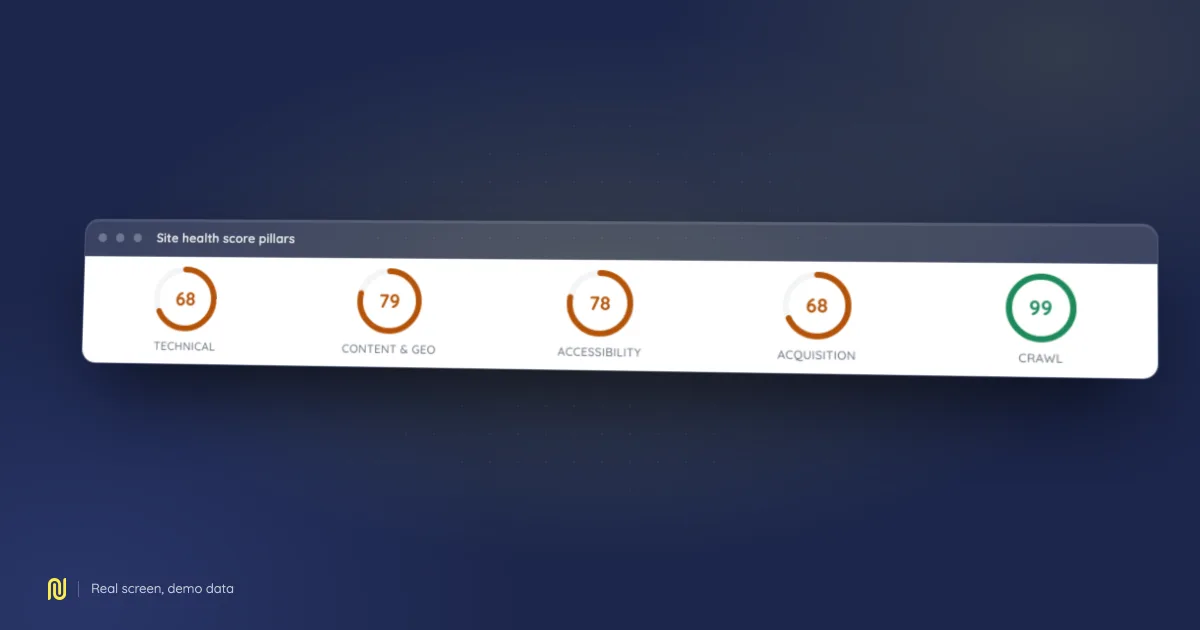
A real product screen, rendered on a fictional demo dataset: the figures shown belong to no client.
Every audit tool grows up on the sites its authors already own. Those are the easiest sites in the world: somebody picked them, knows the server, knows the templates, and knows the exact page where rendering falls over. A tool that behaves well on them has proved nothing. It has learned its lines.
NessFlow is entering an invite-only beta today. The point of this phase is to put the product in front of sites nobody on the team selected, rather than in front of more people. This piece covers what a stranger’s site exposes, which sites we want, and what the phase does not promise.
The failure only a stranger’s site can surface
A measurement tool has two ways to be wrong. The loud one is easy: it crashes, the page stays blank, someone files a ticket within the hour. The quiet one produces a number that looks right, agrees with every other number on the screen, and is false. Nothing goes red, no alert fires, and somebody makes a decision on it.
That second family almost always comes from an assumption its author never knew they were making. A threshold calibrated on whatever sites were nearby. A convention taken as universal because three reference sites happened to follow it.
We fixed a textbook case of it while building. Our AI crawler access report was returning a clean bill of health for a site that had in fact refused every one of our probes. The probe was judging its own rejection, and a blanket rejection looks a lot like an absence of findings. The number was round, the screen was green, and there was nothing behind it.
That defect surfaced because a real site behaved in a way we had not anticipated. There is no unit test for this class of problem. It takes a site that looks nothing like ours, and somebody who knows it well enough to say "that number is impossible".
Seven traits that put an audit tool in the wrong
This is what we mean by a difficult site. Each trait breaks an assumption most tools make without saying so. If yours carries two or three of them, we want to see it.
1. Content that only exists after JavaScript runs. A tool reading server-delivered HTML sees an empty page and reports it as an editorial problem. A tool that renders sees the content, but now depends on a browser, a timeout and a memory budget. Both are wrong in different directions, and word counts, headings, internal links and semantic coverage all shift depending on which one answered.
2. A robots.txt with more than one group. Groups do not stack: a crawler applies exactly one group, the most specific one naming it. A tool that merges the rules returns a false access verdict, and it errs on the reassuring side. This is the single most common mistake we run into.
3. One brand spread across several subdomains. The blog, the store and the help centre are one site in your head and three hosts to a crawler. That boundary decides what counts as an internal link, what counts as duplication, and the scope of every ratio on screen. A tool that draws the line by itself hands you percentages whose denominator matches nothing you would call "the site".
4. Multiple languages. Per-language addresses, hreflang pairs that may or may not be reciprocal, pages translated halfway. A badly declared pair reads as duplication, a half-translated page reads as thin content, and any comparison over time gets shaky the moment one language moves on its own.
5. Volume. Past a certain size an audit stops being an inventory and becomes a sampling problem. The only question that matters then is whether the tool tells you where it stopped. A truncated run silently compared against a complete one manufactures a drop that never happened.
6. An unusual server or content management system. Hand-rolled pagination, a status code used against its meaning (the error page answering 200), headers nobody else sends. Everything an audit tool takes for granted comes from a convention, and a convention can only be tested on the sites that ignore it.
7. Protection at the edge. Application firewall, bot filtering, rate limiting, country blocks. In the best case the crawl fails outright and everyone sees it. In the worst case it half succeeds: throttling kicks in partway through, the tool brings back an arbitrary subset of pages, and the report describes the protection while claiming to describe the site. We cannot yet recognise that case, and it is one of the reasons for this beta.
An eighth trait deserves a mention because it is temporary: a migration in flight. Redirect chains, two templates alive at once, canonicals still pointing at the old address. A site in migration is a difficult site for a few weeks, and those weeks are the best time to watch it.
The limits, written down first
Self-serve stays open. Anyone who just wants the tool needs no invitation, and the beta unlocks no hidden features. It gives you someone to talk to.
Seats are capped by what the team can read. Every audit produced during this phase gets reviewed on our side against the live site. That work sets the size of the wave, and it does not stretch. Access opens in waves, with no announced date.
Beta pricing carries over when general availability opens.
Your data stays yours. Nothing we see gets published, quoted or shown without your written agreement.
Nothing is required in return. A message on the day a number looks wrong to you beats ten hours of interviews, and we are asking no one for either.
How to get in
Write to us through the demo request form and tell us, in one line, what makes your site painful to audit. That is the whole selection criterion: not size, not sector, not budget.
If nothing comes to mind, these three questions are enough:
- does your main content survive with JavaScript disabled?
- how many distinct hosts carry your brand?
- did your last audit tool finish its run, and did it say so?
What to take away
A measurement tool proves itself somewhere other than on the sites that raised it. So we are opening this phase to sites picked for how awkward they are: we want hard cases, not showcases. If yours regularly puts your current tools in the wrong, it is exactly the one we want to see.