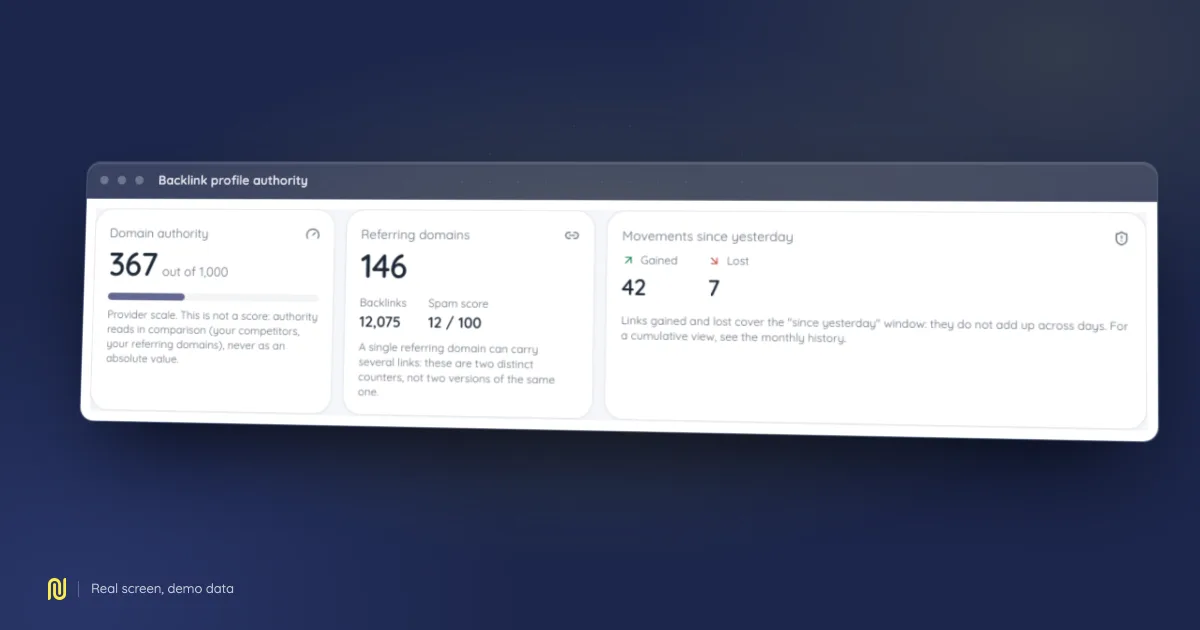
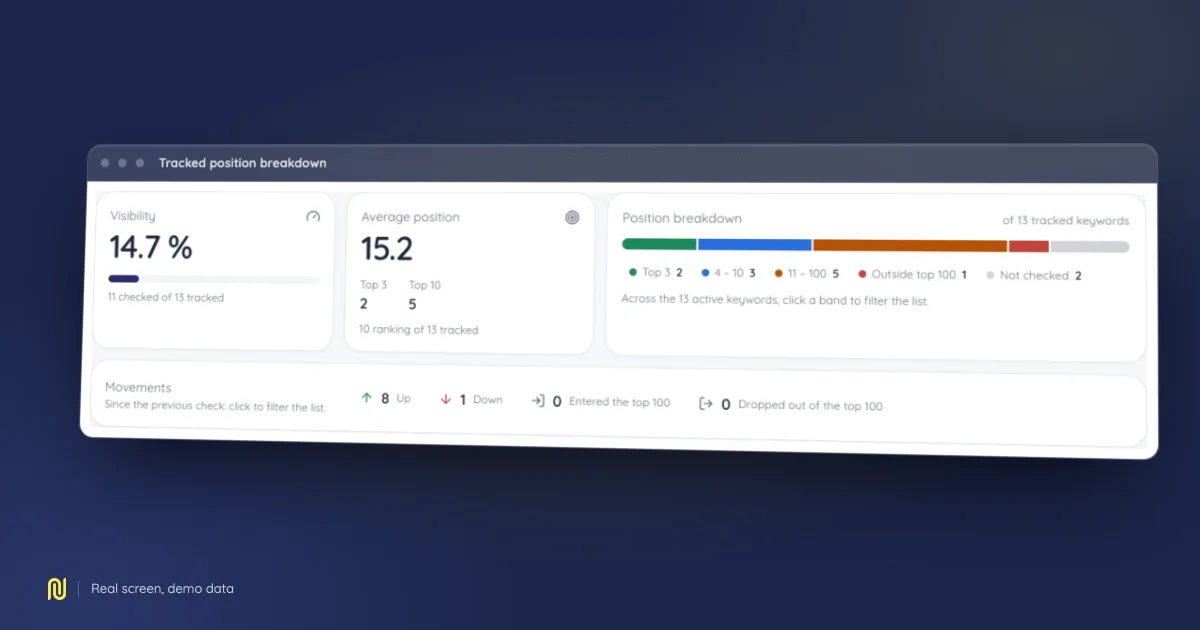
Semantic coverage: what can be measured on a page, and what can only be judged
The most useful border in this subject runs between what you can count on a page and what you can only judge. Both serve the same decision, and blending them into a single rating destroys both.
The NessFlow team (Product engineering, NessFlow) · · 6 min read
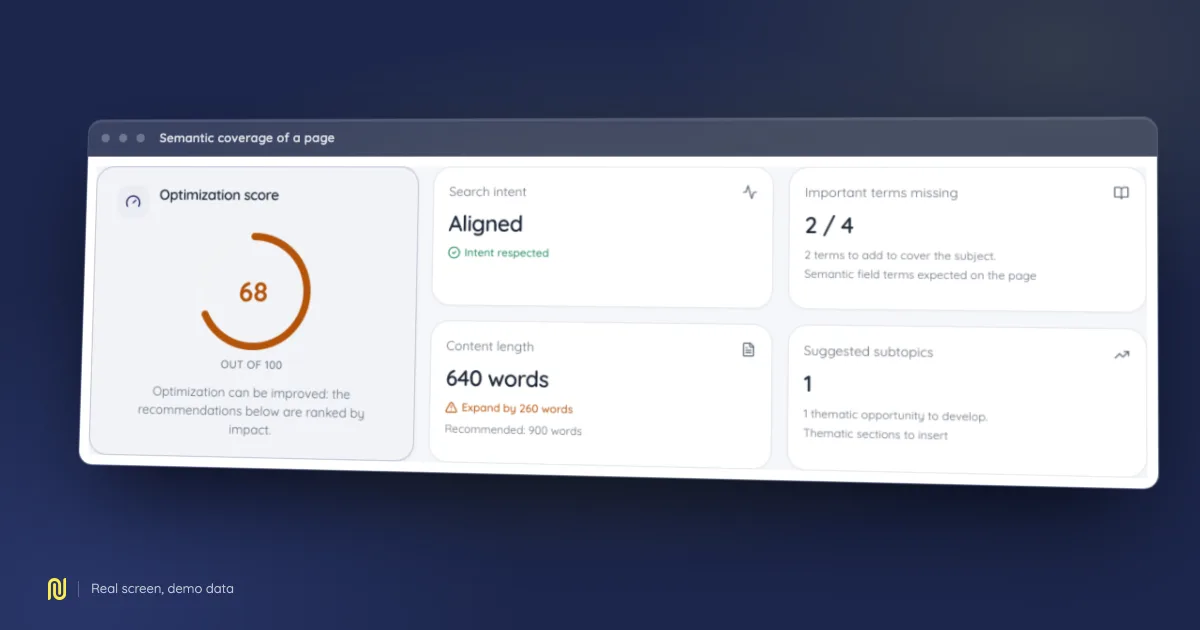
A real product screen, rendered on a fictional demo dataset: the figures shown belong to no client.
“Is this page well optimised?” The question comes up at every review and has no answer, because it blends two things of different natures: what you can count on a page, and what you can only judge.
Separating the two is what makes the subject workable. This article draws the border, then says what to do on each side.
What can be counted
These findings are deterministic: two people who record them get the same result, and a machine replays them identically.
- The presence of an identifiable author. A name, a page describing them. True or false.
- Structured data. Present or absent, valid or not.
- Cited external sources. They count, and their number compares from page to page.
- Text volume. A number, to read with care: it says nothing about quality, but a text that is too short cannot treat a subject.
- The connection and the sharing tags. Technical, binary.
- Occurrences of a term. How many times the page uses a given word: countable, even if the “desirable” threshold belongs to the next section.
Two rules make these counts usable.
The first: a share always travels with its denominator. “40% of your pages have no author” means nothing without knowing how many pages were examined. Over twelve pages, that is five to fix this afternoon; over twelve thousand, it is a programme of work.
The second: an absence of measurement is not a zero. A page the crawl never reached does not have “zero structured data”: it was not examined. Confusing the two makes an indicator collapse on a collection outage.
What can only be judged
On the other side of the border, everything that takes a judgement.
- The intent served. A page can be clearly written and answer a different question from the one it targeted. Spotting that gap is a judgement, grounded in the text.
- The quality of a title. You can check its length and whether it carries the keyword. You cannot measure whether it earns a click.
- What the subject is missing. The list of absent subtopics depends on what the subject calls for, so on domain knowledge.
- Readability. The classic formulas count syllables and words. They approximate something; they do not measure it.
A language model is good at this work, on one condition: that its output be structured and presented for what it is. A list of missing subtopics, a rewritten title, an intent gap explained in three sentences: those are proposals that compare from page to page, that can be argued with, and that are tied to the page's real text.
It is not a measurement, and there is no downside to saying so. The downside appears when you forget.
Why a composite rating lies
The temptation is universal: add both columns and display a rating out of a hundred. Three reasons not to.
It is not reproducible. Run the analysis again on an unchanged page: the judgement part moves by a few points. A rating that varies while the page stands still is not an instrument.
It erases the nature of the findings. “62 out of 100” does not say whether the problem is a missing author, fixable in ten minutes, or an intent that misses the query, which takes a full rewrite.
It is argued with like an opinion and read like a measurement. That is the worst of both worlds, especially in a report handed to a client.
Our position: a rating can help prioritise a hundred pages, provided it is presented as the appreciation it is, and never added to deterministic counts. The counts, for their part, belong in a report, with their denominator.
The finding no single page can give you
There is one defect that neither counting nor judgement finds while reading one page: two of your pages aim at the same query.
Seeing it takes the corpus, meaning every page of the site and its actual content. The symptom is recognisable: the query earns impressions, neither page settles, and the URL that surfaces changes from month to month.
Three ways out, and the order depends on what the measurement shows, never on a standing preference:
- Merge, and redirect the absorbed page to a genuinely equivalent one. The right choice when both pages say the same thing less well.
- Differentiate the intent. One treats the subject head on, the other a specific case, and they cite each other.
- Deindex the weaker one. The last resort, the one that loses the content without recovering it elsewhere.
None of these three moves has ever been the subject of a published controlled test, and the default move, when the measurement does not settle it, is to do nothing. Our protocol for detecting cannibalization separates a real conflict from mere co-presence, and says what each remedy actually has behind it.
Group by meaning, then check with the engine
Once a content plan carries hundreds of queries, grouping them by hand is an illusion. Grouping them by meaning proximity, computed on vectors, works well and fails on edge cases: two queries close in wording can aim at opposite intents.
Hence a simple counterweight, and the best one available: the results pages. Two queries whose results serve largely the same domains aim at the same intent, on the engine's own account. An overlap of a few domains among the first results is the usual benchmark.
Two precautions, both paid for at the first oversight:
- the check REPORTS, it does not recut. Only queries that are actually tracked have a reading: letting the results page arbitrate the grouping would make the shape of your content plan depend on whether a query happens to be tracked, which has nothing to do with its meaning;
- the count travels with its denominator: “three comparable members out of five, three of them confirmed” is information; “confirmed” on its own is not.
The method, in five steps
- Count first. Deterministic findings are free, replayable, and often fix a surprising share of the problem.
- Look for intent duplicates before rewriting anything: rewriting a cannibalised page means improving both sides of a conflict.
- Ask for a structured judgement on the pages that matter, page by page, against an explicit query.
- Fix structure before substance. Title, H1, meta description and subheadings take an hour and change how the page is understood.
- Replay the counts after fixing. It is the only part that proves anything, and the part nobody redoes.
Nothing on this list replaces the decision to write. A tool says what a page covers, what it lacks for a subject, and which of your pages are treading on each other. What you do with that stays an editor's work.